
Selecting a trustee to administer your trust is one of the most critical and personal decisions you will make during estate planning. It is common for grantors to consider family members or friends to serve as an individual trustee. However, since trust administration is an intricate and demanding responsibility, opting for an individual trustee introduces significant risks.
For example, a friend or family member may not have the specialized knowledge to ensure that trust administration complies with applicable local, state, and federal regulations. Their decisions may also be influenced by personal relationships, which can compromise the impartiality required for fiduciary stewardship.
A corporate trustee offers a professional alternative to appointing friends or family members. A corporate trustee is a trust administration company or department within a bank responsible for distributing assets in precise alignment with the grantor’s directives. Generally, a corporate trustee brings expertise and objectivity to trust administration, but not all institutions are the same. Choosing the right corporate trustee for your unique needs ensures your wishes are fulfilled, your legacy is protected, and your loved ones are treated with professionalism and empathy.
The Importance of a Corporate Trustee
The reason why it is important to use a corporate trustee is that trust management and administration can be challenging, time-consuming, and high-risk, particularly when family dynamics are complex or if the trust holds several high-value assets. With complicated estates, the risk of tax errors, inadequate asset oversight, or improper asset distribution increases. Federal and state governments have regulations to mitigate these risks and ensure that trust administration is carried out prudently.
For example, in California, trustees must adhere to the California Probate Code. This body of law outlines the fiduciary duties of a trustee. It also includes a provision called the Uniform Prudent Investor Act, which describes the trustee’s requirements for managing or overseeing the management of investments held by the trust. Noncompliance with the California Probate Code can lead to personal liability for the trustee. Litigation can be a lengthy, difficult process, leading to significant costs and delaying asset distribution.
Trust companies are well-versed in the legal aspects of trust administration. They understand how to interpret various tax and trust laws to fulfill corporate trustee duties. They also know how to interpret complex trust documents to ensure proper asset distribution and prevent misunderstandings among beneficiaries that could otherwise lead to disputes. Corporate trustees maintain records of all trust activities to provide transparency, resolve or prevent disputes, and enable accurate tax filing.
How a Corporate Trustee Works
Although corporate trustee responsibilities vary depending on their institution’s capabilities and relevant laws, in general, the following are fundamental corporate trustee requirements:
1. Distributes Assets to Beneficiaries
The primary function of a corporate trustee is to administer the trust, including distributing assets. Corporate trustees have a duty to carry out the grantor’s specific instructions in a timely and impartial manner.
As an institution rather than an individual, a corporate trustee possesses the collective knowledge to properly administer various types of trusts, including special needs trusts and revocable trusts.
2. Oversees Asset Management
Corporate trustees ensure that all assets, ranging from real estate to financial portfolios, are managed prudently and in accordance with the trust’s objectives. While some corporate trustees manage assets themselves, others delegate management to other professionals, like the grantor’s preferred financial advisors. In the latter, the corporate trustee remains responsible for overseeing asset management and ensuring compliance with regulations, such as the Uniform Prudent Investor Act, as well as the trust’s guidelines.
3. Keeps Records for Compliance and Reporting
A corporate trustee oversees compliance with federal and state tax laws, including making sure annual tax returns are filed accurately and property taxes for any real estate held by the trust are managed properly. They also have the duty to defend the trust against any legal challenges. All of this requires meticulous recordkeeping, which corporate trustees are adept at.
4. Communicates With Beneficiaries
Corporate trustees must keep beneficiaries informed about the administration of the trust. For example, under the California Probate Code, trustees must provide beneficiaries with a report of the trust’s financial activities at least annually.
Corporate trustees are also expected to respond to a beneficiary’s request for a copy of the trust or related information promptly. This expectation stems from the duty to keep beneficiaries reasonably informed.
Benefits of a Corporate Trustee
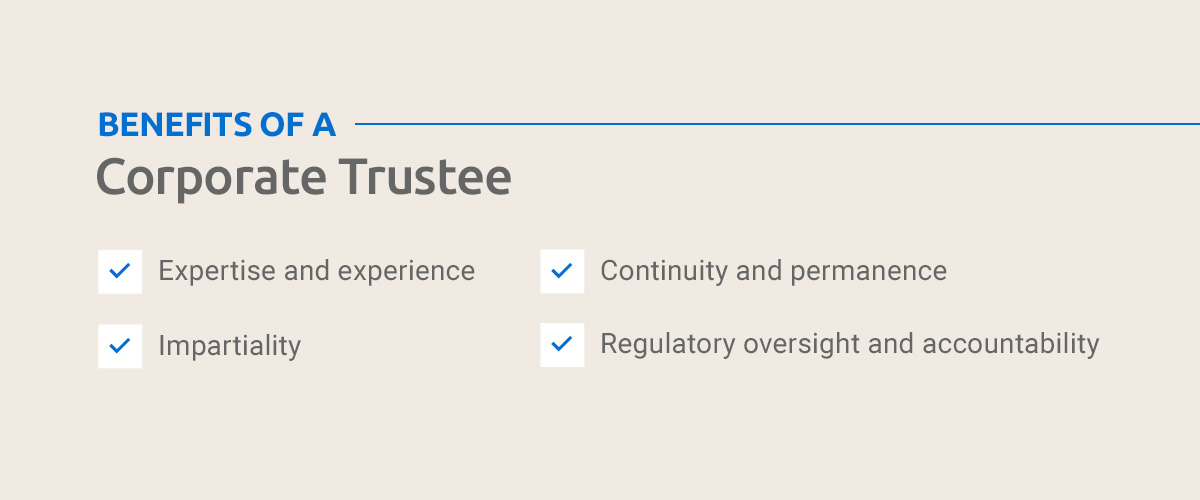
If your trust is complex or holds high-value assets, there are several advantages of partnering with a corporate trustee, such as:
- Expertise and experience: Corporate trustees are experts at trust administration. They work with trusts daily, providing them with a level of experience that individual trustees cannot replicate.
- Impartiality: As a neutral third-party, corporate trustees are not influenced by personal relationships or family conflicts. You can be confident that your corporate trustee will follow your trust’s instructions objectively and be guided by the best interests of all beneficiaries.
- Continuity and permanence: As an organization, a corporate trustee cannot pass away or become incapacitated. It will provide uninterrupted administration of your trust, ensuring its long-term stability.
- Regulatory oversight and accountability: Trust administration companies and banks are subject to rigorous oversight by state and federal authorities. For instance, corporate trustees in California are regulated by the Department of Financial Protection and Innovation. In other words, corporate trustees are held to the highest fiduciary standards, adding another layer of protection to your trust.
How to Choose a Corporate Trustee
Carefully assessing a corporate trustee’s qualities will directly impact whether your trust will be administered with exceptional professionalism and expertise. When choosing a corporate trustee, look for:
- Experience and reputation: Ensure that the trust company has a proven track record of success. You can directly ask the corporate trustee for details about its experience, as well as request references. Your existing team of advisors may provide an unbiased opinion about a particular trust company’s reputation.
- Willingness to support litigation: Some corporate trustees are unwilling to accept appointments that involve a high risk of litigation, such as those involving strained family relationships. Since disputes can arise under any circumstances, consider choosing a corporate trustee with the experience, willingness, and resources to support legal challenges.
- An open architecture approach: Consider if the corporate trustee is willing to work with your existing team of advisors, such as your estate planning attorney, investment advisor, and CPA. This open architecture model enables a holistic, collaborative approach to risk mitigation. It also provides greater flexibility than a trustee requiring complete control of asset management.
- Adherence to regulations: The corporate trustee should have a strong compliance record and be in good standing with applicable regulatory agencies. Confirm whether the company is state- or federally-chartered, and then search for the corporate trustee on the regulator’s website to verify their status.
- Empathy: Trust administration involves more than distributing assets — it is also about building relationships and helping beneficiaries feel understood. Consider whether the people at the trust company listen to your concerns empathetically and show a genuine commitment to your needs.
Questions to Ask a Corporate Trustee
Weighing the pros and cons of a corporate trustee is likely not enough to properly evaluate a particular organization. Meeting with an officer at a prospective trust company and asking questions in person is essential for making an informed decision. Consider asking the following questions:
- What is your experience with trusts of similar sizes and complexity?
- How do you handle conflicts between beneficiaries?
- What is your fee structure, and what services does it include?
- Are there additional fees for certain assets, such as real estate?
- Will you collaborate with my existing advisors?
- What is your process for communicating with beneficiaries to keep them informed of trust activity?
If you decide to move forward with the corporate trustee, ensure there are clear duties and fees disclosed. Review the document thoroughly, ideally with the guidance of your estate planning attorney, and ask for clarification if anything is unclear before formally appointing the trustee.

Secure Your Legacy With California’s Premier Trust Company
Choosing a corporate trustee is a decision that will impact the future of your legacy and generations to come. You deserve a trust company that will be an exceptional steward of your trust, treat your family with utmost professionalism, and deliver peace of mind.
At Peninsula Bay Trust Company, we combine unmatched fiduciary expertise with an empathetic, personalized approach to serve your family’s unique needs. Unlike other trust companies, our experts provide support in the event of legal disputes, serving as a neutral party to review the trust and ensure its instructions are carried out properly. We also offer an open architecture model, meaning we are committed to working collaboratively with your preferred advisors.
With service areas across California, we can partner with you whether you are in the Bay Area, the Greater Los Angeles region, San Diego, or elsewhere in the state. We invite you to contact us to discuss your specific trust administration needs and learn how we can help protect your legacy.